Pages

Showing posts with label ART. Show all posts

Friday, 15 July 2016

Le cadavre exquis (the exquisite corpse)


It seems obvious to emphasize how important the visual nature of the dream is. However, this might be the reason that the major work of Sigmund Freud, The Interpretation of Dreams (1900), had such a big impact on modern art, even greater than in psychiatry and psychology, at least in the early stages.

Although Surrealism emerged as a literary movement inspired by Freud’s theories of the unconscious, nineteenth-century mysticism and Symbolist art and literature, almost at the same time, the movement’s proponents realized the potential of the visual arts to express the imagery of dreams and the unconscious mind. So the practice of drawing, which offers the advantages of immediacy and spontaneity, became the most fertile medium of expression and innovation among the Surrealists.


It also seems obvious to reject the naive and clichéd affirmation that the Surrealist artists “copy” their dreams in their works. Max Ernst complained about it in his text What is Surrealism?(1934), but it is still too common even today.

For them, the dream is what might be termed life’s other fifty percent, a level of experience different from conscious life, the knowledge and liberation of which impinges in a special way on the enrichment and amplification of mental life, which constitutes the Surrealists’ main objective.

They used, in their efforts to bypass the conscious mind and access the subliminal realm, diverse drawing techniques like automatic drawing, frottage, decalcomania, collage, grattage, but some of the most striking surrealist drawings were the “exquisite corpses”.


The “exquisite corpse” is a surrealist game that involved collaboration and chance. It is a method by which a collection of words or images is collectively assembled and is similar to an old parlour game called Consequences. The technique got its name from results obtained in initially by playing: “Le cadaver/exquis/boira/le vin/nouveau” (The exquisite corpse will drink the young wine). Other examples are: “The dormitory of friable little girls puts the odious box right” and “The Senegal oyster will eat the tricolor bread”. These poetic fragments seemed to reveal the unconscious reality in the personality of the group, resulting from a process of what Ernst called “mental contagion”. It was natural that such oracular truths should be similarly sought through images, and the game was immediately adapted to drawing by assigning a section of the body to each player, though the Surrealist principle of metaphoric displacement led to images that only vaguely resembled the human form.


Tristan Tzara (1896-1963) described the rules of the drawing game: “Three (or more) of you sit down around a table. Each one of you, hiding from the others, draws on a sheet the upper part of a body, or the attributes able to take its place. Pass on to your neighbor on the left this sheet, folded so as to conceal the drawing, but for three or four of its lines passing beyond the fold. Meanwhile, you get from your neighbor on the right another sheet prepared in the same way (previously folded perpendicular to the axis of the body to be realized).


André Breton, the founder of Surrealism, considered that with the exquisite corpse we had at our command an infallible way of holding the critical intellect in abeyance and fully liberating the mind’s metaphorical activity. 


In my opinion, the exquisite corpse grasps the atmosphere of the dream in a amazing way, although the results can be sometimes more grotesque than real dreams. Both the spontaneity and the nonsense due to the change of one hand to another, make the magic of the “surreal” arise to its peaks. By the way, it might be an amusing game to partake in when you are out at the bar with your friends, the only thing you need is a pen, a piece of paper (a paper napkin, for example) and want to let fly  your imagination. Knowing how to draw in this particular case is not important, but rather to go into a “surreal adventure”.


Li

Thursday, 31 January 2013

THORNY ISSUES gets all artsy-fartsy this month as we train our discerning gaze on the wide world of ART, with a capital A, R and T. From the neolithic to the neoclassical, the postmodern to the post-traumatic, it’s all here – every line and squiggle, every dab and daub. Get ready, artheads, for some serious visual appreciation. 


My family and modern art


I don't have any skill or talent for art but my relatives do or, at least, they did. As a scientist I prefer science but I enjoy art, any kind of art. Really, I am an exception because almost all the members of my family have been artists. 

Most people don’t understand modern art. Modern art is something that is red and smells like blue. Do you know how the colour blue smells? If you know, you probably understand what modern art is. Nevertheless, here are some tips to identify modern art. If it hangs on a wall, it’s a painting. If you can walk around it, it’s a sculpture. If you have to finish the script, it’s a modern piece of theatre. The best way to tell if a modern painting is finished is to touch it. If the paint is wet, the work isn’t over; if the paint is dry, it is. Anyway, it’s simple: you only have to enjoy it.

I like going to art events with my family. For instance, I like to go to music concerts with my grandfather. He knows a lot about music. When he was young, he was a composer of contemporary music. He met Philip Glass and others such as John Adams and John Cage. He wrote a lot of works, like “Catastrophe, an Epic Poem for 60 Bagpipes and Cello”, “Concert for Typewriter and Orchestra in C minor” and, his masterpiece “Poem for 25 Tenors, a Big Mezzo-soprano and a Chorus of Cats”. Really impressive. But it was never understood. 

My mother is an artist, too. When she was young she lived as a hippie. She listened to psychedelic rock, practised the sexual revolution (with my father, I guess), and used drugs such as cannabis, LSD and mushrooms to reach what she called an altered state of consciousness. She also participated in lots of happenings, especially in those that required nudity. As you know, a happening is a performance where the public participate in an active way and there is not a boundary between the artists and the audience. You know how the thing starts but not how it is going to finish. Even today we continue practicing this type of performance art at home: we have family happenings very often. 

My father was a silent poet. His entire world was inside him and, for sure, it was a colourful one. He never spoke much. I remember a conversation with him, probably the last one, when I was a child and he was painting at the edge of the river, like the impressionist painters used to do, watching the ships pass through. I asked him ‘Dad, how do boats float?’ ‘I don’t know,’ he replied.  I then asked, ‘How do fish breathe?’ ‘I don’t know,’ he replied. ‘Why is the sky blue?’ I asked. ‘I don’t know,’ he replied. ‘Dad,’ I said, ‘You don’t mind if I ask you all these questions, do you?’ ‘Of course not,’ he said. ‘If you don’t ask questions how will you ever learn anything?’ He was a wise and a silent man. When he passed away we didn't notice until dinner.

I am very fond of opera because of my aunt. She was a very famous soprano singer. As you know, opera is that kind of theatre where someone gets stabbed in the back and instead of bleeding, he sings. My aunt looked like a Picasso model, she had a sardine face and crossed eyes, her nose was long, thin and crooked and she was flat-chested, but she really sang very well. She had quite a range at the lower end of the scale. Because of that she was known as the deep C diva.

Finally, I’ll talk about my uncle, the fastest author I know. He wrote a five-hundred-page novel in two weeks about the place where he is living now. He did it by using a technique called automatic writing, used by James Joyce in Ulysses, for instance. The work turned out to be a success, especially for students of psychology and psychiatry. They all are very interested in my uncle's experiences; he is the oldest inmate in the asylum.

If I had had talent enough, I would have liked to be a musician. I love music the most, especially 70s and 80s music. Unfortunately, as I have said, I don't have any skill or talent for art. By the way, last night I had a strange dream about this. I had died and I was on a stage where a lot of instruments were set up. A door opened and Jimi Hendrix, Jim Morrison, Janis Joplin, John Lennon and Otis Redding came in. All of them picked up instruments and started to tune them up.  I walked up to Jimi Hendrix and asked him: “This is heaven, isn't it?” “Heaven?” Jimi said, “Do you think you are in heaven?” And at that moment Karen Carpenter came onto the stage, took her seat at the front and said, “O.K. guys, let's start with Close to You, one, two, three…” I woke up in a sweat. 


                                                                                                      Bart Ptolomy

Wednesday, 30 January 2013

Street art


In the last three years I’ve become addicted to Street Art, and the reason is that I have discovered a new and very different way of enjoying art. 

Some time ago when I used to hear about this phenomenon, it seemed to me vandalism or something without much interest. Now I have fallen in love with it and I am sure this will be forever. This love story started while I was living in Valence where I had moved for work. Very close to the place where I used to live there was an urban artwork called Bonjour Tristesse that every day I used to encounter on my way to work. I found out who the author of this masterpiece was and I discovered Escif - a street artist - with several works around the world. Shortly afterwards, I became a fan of this art and started to capture different photos of urban artwork like this.
Nuria Mora
Why have I remained spellbound by this? Perhaps because this kind of art is fresher than the "official" art and, of course, is off the mainstream. The only sad thing is that in the majority of cases it is short-lived, but that is also part of its charm. Most of these kind of artists are really serious workers and, instead of destroying these places, they create new spaces that ameliorate the environment. That’s what I usually say to people that are against this kind of expression.
Rolling Habbits


Unknown


Rosh
 

Unknown


Unknown


La Nena

With time, most of these artists enter into the mainstream circuits and often become really famous. Something that started as alternative becomes official, and they sell their works for large amounts of money.

Banksy is perhaps the greatest exponent of this art. He is a native of Bristol, one of the main centres of street/urban art.

Perhaps, if after reading this, some interest has been awakened in you about this new open world, there are some initiatives that can help you to learn more about it. The Safaris Urbanos are a very good means of discovering it. Every weekend they organize various tours around Madrid (Lavapiés and Malasaña) where you can enjoy the best works and, why not?, meet interesting new people.
Escif


                                                                                                          Silly Sally

A confusing title?

Dos mujeres tahitianas
Paul Gauguin 1899

“Gauguin and the Voyage to the Exotic”. That was the title of the temporary exhibition organized by the Thyssen-Bornemisza Museum from 9 October 2012 to 13 January 2013. A provocative title for a nice journey to the exotic in Modernism.
But was it appropriate? Was it the most convenient and suitable?    

Why am I wondering this?
Although it’s extremely evocative and provocative, it can confuse you from the beginning to the exhibition’s end.
Why?  
Because, of the 111 artworks that could be contemplated throughout the exhibition’s suggested itinerary, only 33 of them were by Gauguin.
These 111 works were lent by museums, galleries and collections in 13 different countries: Portugal, Sweden, France, the UK, the Netherlands Switzerland, Austria, German, Hungary, Denmark, Russia, Israel and the US, besides Spain.
Aside from the surprise of finding only those 33 Gauguin paintings, the exhibition was an ambitious show, not so much for the number of pieces, but for the outstanding masterpieces done by Gauguin and his followers.
 
Mata Mua (Érase una vez)
Paul Gauguin 1912

During the visit around the rooms, I thought: but this isn’t a Gauguin exhibition! It’s true. The exhibition allowed visitors to notice the importance that the artists' travels had for the history of art. Gauguin shared the billing with a wide range of painters from the late nineteenth and early twentieth centuries who have shown us, frame by frame, how travel to exotic worlds contributed to the emergence of what we now call modernity. And this modern notion was what inspired Gauguin to break from romantic stereotypes and propose a new exotic canon as a model for many artists that followed.

Parau Api (Qué hay de nuevo)
Paul Gauguin 1912
An important selection of works by Kandinsky, alongside paintings by August Macke, Paul Klee and Sonia and Robert Delaunay was gathered together in the space dedicated to the journeys undertaken by early 20th-century in search of a new language based on light and colour. I understood perfectly Gauguin's stamp on artists like Kirchner, Nolde and Kandinsky.

Works by Matisse, Kirchner, André Derain, Henri Manguin and Mikhail Larionov reflected the major influence that the French artist had on the artistic movements of the first decade of the 20th century, such as French fauvism and German expressionism.
I think the exhibition’s title shows the intention of the Thyssen-Bornemisza Museum to demonstrate that Gauguin was the first painter to tackle the exotic in a modern way.
If you missed it, don’t worry! Don’t hesitate to take a virtual visit to the exotic and the different through Martinique, Tahiti, the Polynesian islands, Tunisia and Algeria… , only for you. Click on the link below and off you go

 Thyssen-Bornemisza Museum                               
                                                              
 Flamencodancer   

 Emil Nolde 1914  
                                                                                                                                                                                            

The Cinemaniac Corner


ARTISTS RELATED BY ARTISTS

The definition of art I like the most: art is the quality, production, expression, or realm, according to aesthetic principles, of what is beautiful, appealing, or of more than ordinary significance.

But art covers a huge range of human activities, from the visual disciplines, such as painting, sculpture, photography and architecture to others with a more interactive relationship with the audience, such as theatre, cinema, literature, music and dance.

Although aesthetic values are paramount in the fine arts, we can’t forget the essential technical training needed to achieve some kind of beauty.

I am going to focus on painting. Or if we want to be more accurate, I am going to talk about three painters I deeply admire. But as you have surely already guessed, I suffer a bit from 'cinemania', and that’s why I am going to talk about painting and painters through the eyes of other artists: film makers, film stars, film musicians.

There are three films linked with three great painters that I remember with joy and pleasure.

The first is 'The Agony and the Ecstasy' (1965).

This is one of those great and beautiful Twentieth Century Fox historical films that I enjoyed as a young teenager. However, I admit that when I first saw it, I knew almost nothing about the main character, the great Florentine Renaissance painter Michelangelo Buonarroti.

It is a film based on the biographical novel by Irving Stone, and perfectly reflects how the artist devoted his whole life to his fine work, without a day of rest and with nature as his guide.

But the fact was that when I visited the Sistine Chapel in Rome, I just couldn't get out of my mind the image of Charlton Heston painting the ceiling of this monument up on his scaffold, and I realized how captivated by this artist I was.

Rex Harrison is Pope Julius II in this movie and his relationship with Charlton Heston (Michelangelo) is also a very interesting one psychologically, full of rising tension.


Prior to this and adapted from another Irving Stone novel is another colourful film called 'Lust for Life' (1956), directed by Vincente Minnelli and starring Kirk Douglas as Vincent Van Gogh and Anthony Quinn as Paul Gauguin.

This is a biopic about the brilliant Dutch painter Vincent van Gogh, whose work is so highly valued nowadays, but was so little appreciated during his turbulent life. In fact, he remained very poor and was only able to sell one of his paintings while he was alive.

This movie was filmed in the real locations where van Gogh lived, except for some of the indoor scenes. For instance, some scenes were shot in the church where his father used to preach in Holland, while others were filmed in several locations of Paris where he met with his Impressionist colleagues. We can also see the real sites of many of his most highly regarded paintings in the southern French fields of Arles, and even inside the mental hospital to which he was committed.

Although it is a little bit like a documentary movie in some parts of the story, I would note how well the character’s passion and instability are depicted.

Another remarkable aspect is his relationship with his colleague Gauguin, another genius but so different from himself: dynamic, extroverted womanizing. It is very interesting to observe how each of them would envy the other for different reasons.      

And isn’t the leading actor well chosen? Aren’t there quite a lot of similarities between Vincent van Gogh and Kirk Douglas?


And finally, I recommend a Spanish movie by Victor Erice, filmed together with the real artist, the great Manchegan painter Antonio López. Its Spanish title is 'El sol del membrillo' (1992), translated into English as 'Quince Tree of the Sun'.

The film is somewhat unclassifiable, half documentary about an artist’s process of creation, half psychological reflexion about time, colour and art itself.

The plot is simple: years earlier, Antonio López planted  a quince tree in his own garden, and it was in the fall of 1990 that he planned to paint it, just when the fruit was starting to ripen.

Antonio López goes on talking about the painting, about the tree, about his technique. Talking with people who happen to visit him while he is working; and most of all, talking about light and time. You really get into his sensations and waking dreams.

It may seem a boring film, but you completely forget about time when you are watching it, lost in its beauty.


The Thanksgiving Turkey


Tuesday, 29 January 2013

The art of fashion


Jean Paul Gaultier's last Madrid exhibition: The Universe of Fashion. From the sidewalk to the catwalk.


This exhibition was the last one I have seen and I liked it so much that I am going to share it with you. I hadn't ever seen an exhibition about a fashion designer but it was very spectacular as well as instructive. Unfortunately, it ended on January 6th, but I will try to explain the best of it.

One of the most interesting things about the exhibition was the use of mannequins with animated faces. This was achieved by projecting holograms on the surface of their faces and the results were surprising, as you could see their eyes and mouths moving as if they were almost real. Also, many of them speak and sing, which makes them seen even more human.

The exhibition was divided among seven rooms, which were: 

- THE ODYSSEY OF JEAN PAUL GAULTIER
- THE BOUDOIR
- SKIN DEEP
- PUNK CANCAN
- URBAN JUNGLE
- METROPOLI
- JEAN PAUL GAULTIER & PEDRO ALMODÓVAR

The first room is called The Odyssey of Jean Paul Gaultier, which included a mannequin that resembled the designer and analyzed Gaultier's interest in sailor-style striped shirts. It's possible to notice the influence of women (he was brought up by women), and he is fascinated with typical female figures, such as mermaids and virgins.


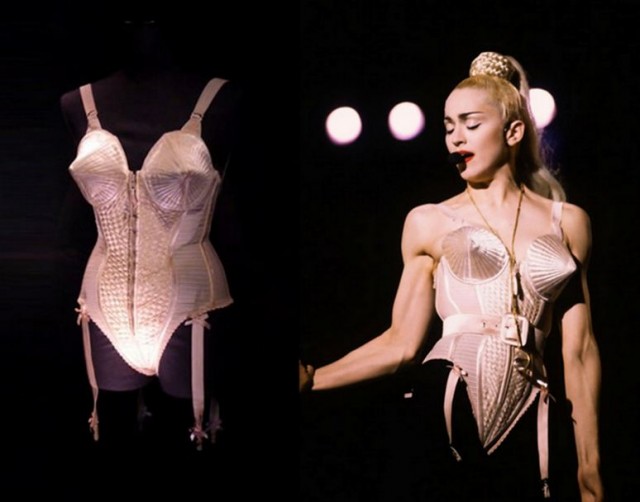
The next room, The Boudoir, explores Gaultier's fascination for underwear, which culminated in his collaboration with Madonna during her Blonde Ambition Tour, and the invention of her legendary conical falsies. He reinterprets corsets, symbols of the imprisioned female body. Although Gaultier's corseted women seem to be a negation of feminist struggles, in reality the corset, far from being an instrument of torture that restricts women's bodies, now embodies the new empowerment of the female and forms a counterpoint to the male jacket, distant progeny of the medieval knight's suit of armour.


Skin Deep is a daring and provocative gallery with clothes inspired by themes of slavery and the art of the human body. In opposition to the rule of thinness, he likes to show the sensuality of plus sizes. The designer also introduces a diversity of genres, offering everyone the freedom to choose their own identity: über woman, butch, trophy girl, boy-toy... He writes a new page in the history of fashion, exploring masculine, feminine, androgynous and alternative conventions with new ideas, such as his skirt for men.


Punk Cancan presents the dichotomy between the typical customer luxury French couture and the street punks of London. The designer reinterprets the hallmarks of Parisian women: beret, trench coat, cigarette holder, houndstooth checks, gingham and baguette. At the same time, after his trip to London, he starts exploring a non-conformist fashion, inspired by the punks of Trafalgar Square, and rock stars such as David Bowie. Penury would force him to be inventive: the total rebellion, trash and "destroy" looks appealed to him.


Urban Jungle analyses the designer's multicultural influences. From hussars, mongols, and Jews to Frida Kahlo and China, he shows his fascination with differences. He combines worlds that have been isolated because of fashion standards, mixing societies and individuals separated by language, custom and geography. He creates a blend of Africa and Europe by making boubous out of miniskirts and placing fezzes on his models' heads.  


In Metropoli he turns for inspiration to the science fiction universe and the sounds of new wave and house music. He uses different materials, from vinyl, lycra and neoprene to prêt à porter, and creates innovative blends like neoprene-coated leather, 3D textiles and even inflatable fabrics. He also shows his first pieces of electronic jewellery. This futurist vision of fashion is also reflected in his collaborations with pop-rock stars who wear his designs onstage or in their videos: Tina Turner, Nirvana, Lady Gaga, Red Hot Chili Peppers, Depeche Mode, Beyoncé, Kylie Minoge and, of course, Madonna. Gaultier goes so far as to create costumes for French ballets and even for flamenco dancers such as Joaquín Cortés. 


Jean Paul Gaultier & Pedro Almodóvar shows the relationship between designer and film director. Although Almodóvar isn't the only film director which whom Gaultier has worked, he is definitely  the one he has collaborated most, and with his designs he has been able to heighten the drama of Almodóvar movies. Kika, Bad Education and most recently, The Skin I Live In, are some of the films on which they have worked together, and you can notice Gaultier's unmistakable style in the irreverent costumes in each one.


This has been a summary of this fascinating exhibition. The pity is that when you finish visiting it you can't try any of these wonderful dresses on...


                                                                                                                   Gajito